

 Aug 20,2026
AI workloads are pushing server rack power densities past 50kW per rack. Traditional air cooling can no longer keep up. Liquid cooling has become the standard, and with it comes a new set of engineering demands—particularly around the valves that isolate and control coolant flow throughout the system.
If you have spent any time specifying components for liquid cooling distribution units (CDUs) or secondary loop piping, you have likely encountered both integrated butterfly valves and two-piece butterfly valves. On paper, they appear to do the same job. In practice, the differences become apparent—especially when reliability, maintenance, and space constraints are factored in.
The Problem with Two-Piece Butterfly Valves in High-Density Environments
High-density rack cooling is unforgiving. Every component must perform consistently, and downtime is not an option. Two-piece butterfly valves have been a workhorse in industrial piping for decades, but they were not designed for the specific demands of modern liquid cooling loops.
The fundamental issue lies in the construction. A two-piece butterfly valve consists of two body halves bolted together. That bolted joint represents a potential leak path. In cooling systems that cycle frequently, valve seats can experience wear over time, and lower-quality valves may develop leakage as sealing surfaces degrade. Even a small leak in a high-density rack environment can damage sensitive electronics, interrupt services, and create operational risks.
Beyond the leakage risk, two-piece designs introduce other complications. Their bolted construction makes them heavier and bulkier—a real drawback when working within the confined spaces of a CDU cabinet or rack-level piping. The additional joint also means more potential points of failure and more maintenance overhead.
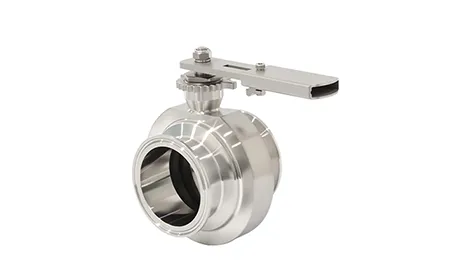
What Makes an Integrated Butterfly Valve Different
An integrated butterfly valve—sometimes referred to as a one-piece welded butterfly valve—eliminates the bolted joint entirely. The body is constructed as a single, unified structure, typically using argon arc welding to fuse the components into a seamless assembly.
This seemingly simple design change has profound implications for liquid cooling applications. Without the bolted joint, there is no body joint leakage to worry about. The sealing integrity relies on the valve's internal seals rather than on maintaining bolt torque across thermal cycles.
The integrated butterfly valve available from QINFENG, for example, features a forged stainless steel disc that meets ASTM A182 standards, paired with a triple-seal design that ensures reliable long-term performance. The stem is guided by a PTFE self-lubricating bushing, which contributes to smooth, low-torque operation even in tight spaces.
Four Reasons High-Density Cooling Demands an Integrated Butterfly Valve
Zero Leakage Path
The most obvious advantage is the elimination of the body joint. In a two-piece valve, the gasket or seal between the two body halves is a potential failure point. Temperature fluctuations—common in cooling loops that must respond to variable heat loads—cause expansion and contraction that can compromise bolted joints over time. An integrated butterfly valve removes this variable entirely.
Lower Operating Torque
The eccentric weld design of a quality integrated butterfly valve protects seals from heat damage during welding and results in lower operating torque than conventional two-piece valves. In a CDU where multiple valves may be packed into a small footprint, lower torque means easier manual operation and less strain on actuators.
Compact Footprint
Space is at a premium in high-density rack environments. CDUs are becoming more compact, and every millimeter counts. The integrated construction eliminates the flange or bolting arrangement that adds bulk to two-piece designs. The result is a valve that fits more easily into tight piping layouts.
Material Compatibility
Integrated butterfly valves are available in 304 and 316L stainless steel, fully degreased and ready for dielectric fluids and high-purity coolants. They handle water and glycol mixtures up to 50% concentration, with an operating temperature range from -40°C to 100°C. This compatibility matters when specifying valves for systems that may run different coolants across different loops.
The Maintenance Advantage: Inline Service Without System Shutdown
One of the most compelling arguments for choosing an integrated butterfly valve over a two-piece alternative is the ability to perform inline maintenance.
In a typical liquid cooling loop, isolating a branch for service traditionally means shutting down the entire system or at least a significant portion of it. With an integrated butterfly valve, the procedure is straightforward: close the valve disc to isolate the branch line, remove the bolts on the branch-side connection, and service the downstream components while the main cooling loop remains pressurized and operational.
This capability is not just a convenience—it is a operational necessity in environments where uptime is measured in nines. The ability to service a branch without draining the system or taking racks offline translates directly to higher availability and lower operational risk.
Technical Specifications That Matter
When evaluating an integrated butterfly valve for a high-density cooling application, several technical parameters deserve attention.
The nominal pressure rating of PN10/PN16 covers the typical operating ranges of most liquid cooling systems. Connection options include Tri-Clamp per ASME BPE and weld ends per DIN 11850 or ASME BPE, providing flexibility for different piping specifications.
Testing is another area where quality matters. Reputable manufacturers test every valve—100% shell hydrostatic testing and seat leakage testing, with helium mass spectrometer verification for stem and body sealing. The test standards referenced include GB/T 13927 and API 598.
For a high-density rack application, these tests are not just checkboxes. They are the difference between a valve that performs reliably for years and one that introduces risk into the cooling system.
Summary
Choosing between an integrated butterfly valve and a two-piece butterfly valve is not just about comparing specifications on a datasheet. It is about understanding the operating environment—high-density racks, 24/7 operation, zero tolerance for leaks—and selecting components that match those demands.
An integrated butterfly valve offers:
- A seamless, welded body that eliminates the bolted joint leak path
- Lower operating torque for easier actuation in confined CDU spaces
- A more compact footprint that fits tight piping layouts
- Full material compatibility with water and glycol-based coolants
- Inline maintenance capability that keeps the system running during service
For data center operators, system integrators, and OEMs specifying liquid cooling components, the choice has become clearer. When reliability matters and downtime is not an option, the integrated butterfly valve is the configuration that delivers.
Ready to Specify an Integrated Butterfly Valve for Your Cooling Loop?
Every cooling loop has unique requirements—flow rates, pressure drops, coolant type, space constraints. Whether you are designing a new CDU, retrofitting an existing rack, or standardizing components across multiple facilities, the right valve configuration makes a difference.