

 Aug 15,2026
Internal leakage in a ball valve is one of those problems that can quietly undermine system performance for weeks before anyone notices. The valve appears closed. The handle is in the correct position. But fluid keeps moving — just a trickle, maybe less — slowly compromising temperature control, reducing cooling efficiency, and wasting energy.
For liquid cooling systems in data centers and CDU applications, even a small internal leak in a Safety Interlock Ball Valve can have cascading effects. Coolant bypasses the intended loop. Rack temperatures drift. Pump energy increases to compensate. And because the leak is internal — hidden inside the valve body — it doesn't present the obvious signs of an external drip or puddle.
The conventional solution has always been the same: shut down the system, disconnect the piping, remove the valve, and inspect it on a bench. But that means downtime. And downtime costs money.
What if you could detect internal leakage without taking the valve out of the pipeline? You can. Here's how.
Why Internal Leakage Is Harder to Spot Than You Think
External leakage is easy. You see a drip. You find a puddle. You know where the problem is.
Internal leakage is different. The valve body contains the fluid. The leak happens across the ball-seat interface when the valve is supposed to be closed. The coolant passes through — just a small amount — and mixes with the downstream flow. No visible evidence. No alarm. Just a gradual decline in system performance that maintenance teams often attribute to other causes.
A Safety Interlock Ball Valve is designed with robust sealing features, including triple stem sealing and precision-machined ball surfaces. But no valve is immune to wear. Particles in the coolant, thermal cycling, and normal actuation cycles can all degrade the seat over time. The question isn't whether a valve can develop internal leakage. The question is how you find it before it becomes a system-wide problem.
Non-Invasive Detection Method 1: Ultrasonic Testing
Ultrasonic leak detection is one of the most practical non-invasive methods available for a Safety Interlock Ball Valve.
Here's how it works: when fluid passes through a small leak path under pressure, it generates turbulence. That turbulence produces high-frequency sound waves — typically in the ultrasonic range — that travel through the valve body and the adjacent pipe wall. A contact ultrasonic sensor placed on the exterior of the valve or the pipe can pick up these signals.
The key advantage? You don't need to shut down the system. The sensor attaches to the outside of the valve body, and within minutes, you have a reading. Modern ultrasonic inspection tools can even distinguish between normal flow noise and the specific acoustic signature of a leak. Some systems use AI algorithms to estimate leak rates based on the ultrasonic signal characteristics.
For maintenance teams managing multiple cooling loops, ultrasonic testing offers a quick screening method. You can check a Safety Interlock Ball Valve during routine rounds, identify potential issues early, and prioritize which valves need attention — all without touching a wrench.
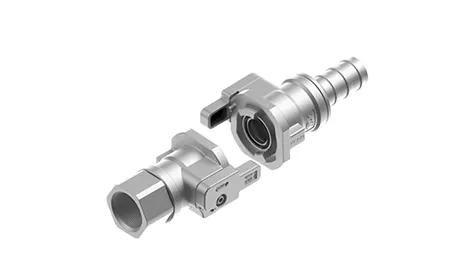
Non-Invasive Detection Method 2: Acoustic Emission Technology
Acoustic emission (AE) takes the ultrasonic concept a step further.
Whereas ultrasonic testing typically uses an active signal (you send sound into the material and listen for changes), acoustic emission is passive. The sensor listens for the energy released by the leak itself. When a pressurized fluid escapes through a microscopic gap in the ball-seat interface, it generates stress waves that propagate through the metal. AE sensors mounted on the valve body detect these waves in real time.
Research has shown that acoustic emission technology can detect internal leakage in ball valves with high sensitivity. The method is particularly effective for online monitoring — you can install permanent AE sensors on critical Safety Interlock Ball Valves and continuously track their sealing integrity.
For liquid cooling applications where unplanned downtime is unacceptable, AE monitoring provides early warning. A gradual increase in AE activity from a specific valve signals that the seat is wearing. You can plan maintenance during a scheduled window rather than responding to an emergency failure.
Non-Invasive Detection Method 3: Pressure Decay and Isolation Testing
If you have the ability to isolate a section of the cooling loop, pressure decay testing offers another reliable method for detecting internal leakage in a Safety Interlock Ball Valve.
The principle is simple. Close the valve. Isolate the downstream section. Monitor the pressure on the upstream side. If the pressure drops over time while the valve is closed, fluid is passing through the seat — internal leakage is present.
For a Safety Interlock Ball Valve used in a CDU or rack-level cooling connection, this test can be performed without removing the valve from the system. You do need to temporarily stop flow in that branch, but you don't need to drain the entire loop or disconnect piping.
The sensitivity of pressure decay testing depends on the pressure differential, the volume of the isolated section, and the test duration. For high-sensitivity requirements, helium tracer gas methods can be used — pressurizing the upstream side with helium and using a mass spectrometer to detect any helium that passes through the closed valve. This approach can detect leaks as small as 1×10⁻⁶ mbar·L/s.
Non-Invasive Detection Method 4: Temperature Differential Analysis
Internal leakage in a Safety Interlock Ball Valve often produces a subtle temperature signature.
If the valve is closed but fluid is leaking through the seat, the downstream side will gradually approach the temperature of the upstream fluid. In a cooling system, that means the downstream pipe may be slightly warmer than it should be when the valve is closed.
Infrared thermography can detect these temperature differences. Scan the valve body and the adjacent pipe sections. A temperature gradient across the closed valve — warmer on the upstream side, cooler on the downstream — is normal. But if the downstream side is warmer than expected, internal leakage may be the cause.
This method is less precise than ultrasonic or AE testing, but it's fast, completely non-contact, and requires no system shutdown. For a quick field check of a Safety Interlock Ball Valve, thermal imaging provides a useful initial screening.
When to Call It: Knowing When a Valve Needs Replacement
Non-invasive detection methods are excellent for identifying internal leakage, but they can't fix the underlying problem. Once you've confirmed that a Safety Interlock Ball Valve is leaking internally, you have a decision to make.
Some internal leaks can be resolved by cycling the valve open and closed a few times to dislodge debris from the seat. Others require seat replacement. If the ball surface itself is damaged, the valve may need to be replaced entirely.
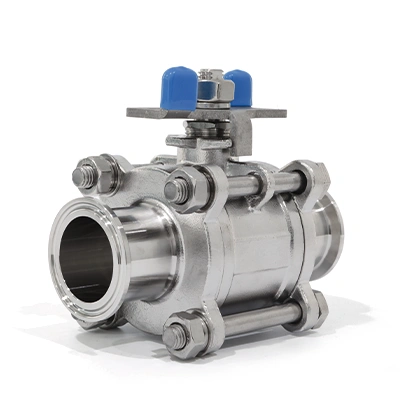
The good news is that many Safety Interlock Ball Valves are designed with maintenance in mind. Three-piece body construction allows seat replacement without removing the valve from the pipeline — a significant advantage over welded or one-piece designs. But that's a topic for another guide.
For now, the key takeaway is this: internal leakage in a Safety Interlock Ball Valve doesn't have to be a mystery. With ultrasonic testing, acoustic emission monitoring, pressure decay analysis, or thermal imaging, you can detect the problem early, plan your maintenance strategically, and keep your cooling system running at peak efficiency.
Need Help Diagnosing a Valve Issue?
Every cooling loop has unique operating conditions, and not every detection method works equally well in every application. If you're unsure which approach is right for your system — or if you'd like to discuss valve selection, sizing, or maintenance strategies — our engineering team is here to help.