

 Sep 08,2026
Coolant leaks are one of the most persistent problems in liquid cooling systems. A single failed seal can mean unplanned downtime, equipment damage, and hours of troubleshooting in a crowded data center aisle. Most butterfly valves on the market look similar on the outside, but the difference between a valve that stays tight for years and one that starts weeping within months often comes down to what you cannot see—the body construction.
If you are specifying components for a CDU, manifold skid, or rack-level cooling loop, the choice of valve directly affects system reliability. A bolted butterfly valve relies on multiple flange joints and gaskets to maintain integrity. Each joint is a potential leak path. The integrated butterfly valve takes a fundamentally different approach: the body is welded into a single, continuous piece. No bolts. No flange gaskets. No joints to fail.
What Makes One-Piece Welded Construction Different
In a conventional butterfly valve, the body is assembled from separate pieces held together by bolts and sealed with gaskets or O-rings. Over time, thermal cycling, vibration, and pressure fluctuations can cause these bolted joints to loosen or the gaskets to degrade. The result is a slow, persistent leak that is difficult to pinpoint and expensive to fix.
A one-piece welded body eliminates this vulnerability entirely. There are no joint surfaces between body sections, which means fewer potential leak points and higher sealing reliability. For liquid cooling systems running water or glycol mixtures 24 hours a day, seven days a week, this difference is not academic—it directly translates to fewer service calls and lower total cost of ownership.
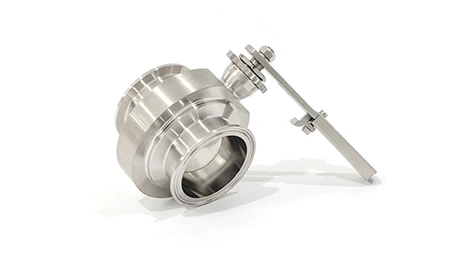
The integrated butterfly valve from QINFENG takes this approach with a fully welded stainless steel body available in 304 or 316L. The design is rated to PN10 and PN16, with a temperature range spanning -40°C to 100°C, making it suitable for chilled water loops and glycol-based cooling circuits alike.
Triple Seal Design: Redundancy Where It Counts
Body construction is only half the story. The other critical leak path in any butterfly valve is the stem—the shaft that connects the handle or actuator to the disc inside the flow path. Stem seals experience constant friction during operation, and over time, wear can compromise their effectiveness.
The QINFENG integrated butterfly valve addresses this with a triple-seal stem design. Multiple redundant sealing elements work together to contain the media, even if one seal experiences wear. This is particularly important in liquid cooling applications where the valve may cycle open and closed frequently throughout the day. A single sealing layer might hold up under ideal conditions, but redundancy provides a margin of safety that mission-critical cooling systems require.
Material Compatibility for Water and Glycol Service
Not all elastomers handle glycol mixtures well. Ethylene glycol and propylene glycol—common antifreeze agents in liquid cooling loops—can be chemically aggressive toward materials not specifically formulated for the service. EPDM is widely recognized as the preferred seat material for water and glycol applications because it remains chemically inert to both ethylene and propylene glycol, whereas other rubbers can degrade over time.
The integrated butterfly valve uses EPDM sealing rings and O-rings throughout, ensuring compatibility with water and glycol concentrations up to 50%. The valve body and disc are constructed from forged 304 or 316L stainless steel, and the entire assembly is fully degreased—ready for dielectric fluids and high-purity coolants without additional preparation. A PTFE self-lubricating bushing reduces operating torque, making the valve easy to operate even in confined spaces where leverage is limited.
Compact Footprint for Space-Constrained Installations
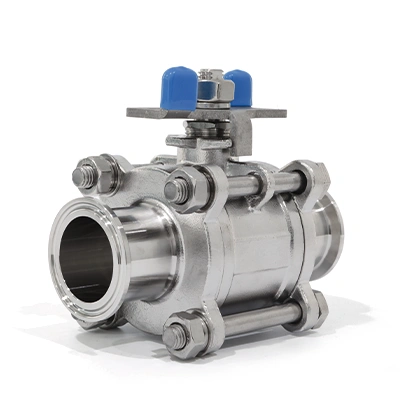
Data center cooling infrastructure is dense. CDUs, manifold skids, and rack-level distribution systems leave little room for oversized components. The integrated butterfly valve is available in sizes from 2 inches to 8 inches, with both Tri-Clamp and weld-end connection options. The Tri-Clamp configuration enables quick installation and removal without tools, while the weld-end option provides a permanent, leak-proof connection for applications where service access is limited.
Overall dimensions are compact, with face-to-face lengths as short as 76mm for a 2-inch valve and 82mm for a 4-inch valve. This makes the valve suitable for integration into prefabricated piping modules and tight CDU enclosures where every millimeter counts.
Testing and Quality Assurance
A valve is only as good as the testing that backs it. The QINFENG integrated butterfly valve is tested to GB/T 13927 and API 598 standards, with each unit subjected to pressure and leak tests before shipment. This is not a token check—it is a verification that the one-piece welded body, triple stem seals, and EPDM seat all perform as specified under real-world conditions.
For system integrators and facility operators, this level of testing provides confidence that the valve will perform from day one and continue to perform over years of service. The valve is also supported by a one-year warranty covering the entire unit, with wearing parts supplied at no charge during the first year.
Summary
Coolant leaks are avoidable. The choice of valve body construction, sealing design, and material compatibility all play a role in determining whether a liquid cooling system stays tight or develops problems over time. The integrated butterfly valve with one-piece welded construction eliminates the most common leak path—body joints—while triple stem seals and EPDM compatibility address the other major failure modes.
What to take away:
- One-piece welded body eliminates flange joint leakage
- Triple stem seal design provides redundant protection
- EPDM seals compatible with water and up to 50% glycol mixtures
- 304/316L stainless steel construction, fully degreased
- Available in Tri-Clamp or weld-end configurations from 2" to 8"
- Tested to GB/T 13927 and API 598 standards
Have a specific cooling loop requirement in mind?
Whether you are designing a new CDU, upgrading an existing manifold system, or looking for a reliable shut-off valve for a glycol cooling circuit, we can help. Contact our engineering team to discuss your pressure ratings, connection preferences, and any custom configuration needs for your next liquid cooling project.