 Aug 05,2026
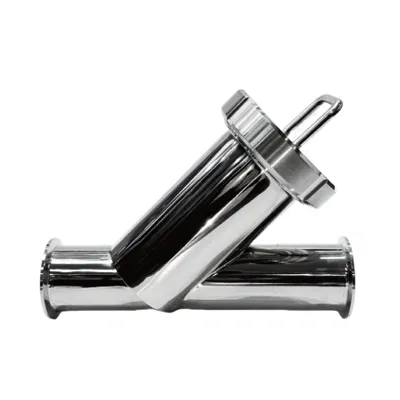
Walk any plant room or utility corridor and you will spot it tucked right before a control valve or pump: the Stainless Steel Y-Strainer. Not glamorous, but it quietly saves seals, orifices, and meters from grit, rust, and debris. The real question is not whether you need one—it is whether the one you choose will last.
On paper, most stainless steel Y-strainers look similar. Same Y-shaped body, similar flange or threaded connections, comparable screen options. But the difference between a strainer that runs for a decade with routine blowdowns and one that fails within eighteen months often comes down to one thing: material compatibility.
A Stainless Steel Y-Strainer is made up of multiple components—the body, the screen, the gasket or seal, the cover bolts, and in some designs, the stem that supports the screen. Each of these parts interacts with the process fluid differently. Choose a material that is not compatible with your fluid chemistry, temperature, or pressure, and you are looking at premature corrosion, gasket degradation, screen rupture, or all three.
So what actually matters when evaluating material compatibility for a Stainless Steel Y-Strainer? Let us break it down component by component.
Body Material: 304 vs 316 and Beyond
The body is the backbone of any Y-strainer. It houses the screen, contains the pressure, and must withstand whatever flows through your pipeline.
Most stainless steel Y-strainers are available in two primary grades: 304 and 316 stainless steel. SS304 is a solid choice for general industrial and commercial applications. It offers good corrosion resistance and machinability, and it performs well in water, oil, and mild chemical services. Field data shows that 304 stainless steel averages five to seven years in mild chemical service.
SS316 takes things a step further. The addition of molybdenum gives it superior resistance to chlorides and acidic environments. For applications involving saltwater, chemical processing, or steam condensate, 316 is the preferred option. The same field data shows that 316L provides twelve to fifteen years of resistance in similar conditions.
When should you look beyond 304 and 316? For severe chloride environments—think marine applications, desalination plants, or coastal facilities—super duplex alloys can deliver twenty-five or more years of service life. For most industrial applications, however, 316 stainless steel offers the best balance of corrosion resistance and cost-effectiveness.
Gaskets and Seals: The Overlooked Weak Point
Here is where many buyers trip up. They specify a 316 stainless steel body and screen, but they overlook the gasket. The gasket is the seal between the cover and the body, and it is often the first component to fail.
The right gasket material depends entirely on your operating temperature and fluid chemistry. EPDM gaskets work well for water, mild chemicals, and temperatures up to about 150°C. They are common in HVAC and water treatment applications. For higher temperatures—steam lines, for instance—graphite gaskets are the standard choice. Graphite can handle temperatures up to 400°C and beyond without degrading.
PTFE (polytetrafluoroethylene) gaskets are the answer for aggressive chemical service. For hydrochloric acid, hydrofluoric acid, or concentrated sulfuric acid, a PTFE-lined strainer or PTFE gasket can extend equipment life dramatically. One chemical plant that switched to a PTFE-lined design for 98% concentrated sulfuric acid saw equipment life extend from six months to five years.
The takeaway? Match your gasket material to your process fluid. A stainless steel body with the wrong gasket will leak—and a leaking strainer is a failed strainer.
Screen Material and Mesh Selection
The screen is the working heart of the Stainless Steel Y-Strainer. It captures debris, protects downstream equipment, and must maintain its shape and filtration efficiency under pressure.
Most stainless steel Y-strainers use 304 or 316L stainless steel screens. Perforated screens offer greater structural strength for heavy-duty applications, while woven mesh allows finer particle capture. Mesh sizes typically range from 20 mesh (coarse) to 200 mesh (fine), with custom options up to approximately 400 mesh.
The compatibility consideration here is twofold. First, the screen material must resist corrosion from your process fluid. Second, the mesh size must match your particle load. Go too fine—say, 200 mesh on a dirty glycol loop—and you will be cleaning the screen weekly. Go too coarse, and debris passes through to damage your pump or control valve.
For abrasive fluids, consider a duplex screen or a perforated plate with a mesh liner for added durability. For viscous media, a larger body size helps keep velocity down and prevents excessive pressure drop.
Galvanic Corrosion: A Hidden Risk
One compatibility issue that does not get enough attention is galvanic corrosion. When two dissimilar metals are in contact in a conductive fluid, one metal acts as an anode and corrodes faster than it would alone.
This matters for Stainless Steel Y-Strainer components because different parts may use different alloys. A stainless steel body with a bronze screen might be safe in non-conductive fluids, but in seawater or other conductive media, galvanic corrosion can become a serious problem.
The safest approach? Match materials across all wetted components. All-stainless construction—body, screen, stem, and bolts—eliminates galvanic concerns in most applications. If you must mix materials, consult a corrosion engineer or refer to galvanic compatibility charts.
Temperature and Pressure: The Overlooked Limits
Material compatibility is not just about chemical resistance. It is also about temperature and pressure.
A Stainless Steel Y-Strainer rated for 300 psi at ambient temperature may not handle 300 psi at 400°C. High temperatures reduce material strength and accelerate corrosion. Differential thermal expansion between components can also cause stress, deformation, or leakage.
Verify your strainer's pressure-temperature rating against your operating conditions. For steam systems, stainless steel strainers with graphite gaskets and high-pressure ratings are essential. For cryogenic applications, low-temperature impact-tested bodies may be required.
Always check the ANSI or ASME class rating before purchase. A strainer with inadequate ratings is a liability—not an asset.
Summary
Choosing a Stainless Steel Y-Strainer is not just about picking a body material off a spec sheet. It is about understanding how every component—body alloy, gasket material, screen mesh, and fasteners—interacts with your specific process fluid, temperature, and pressure.
What to take away:
- Match the body material to your fluid — SS304 for general service, SS316 for chlorides and aggressive chemicals
- Select the right gasket — EPDM for water and mild chemicals, graphite for steam, PTFE for aggressive acids
- Choose the screen mesh carefully — fine enough to protect downstream equipment, coarse enough to avoid frequent clogging
- Watch for galvanic corrosion — keep materials consistent across all wetted components
- Verify temperature and pressure ratings — a strainer that meets the spec on paper may not meet it at operating temperature
Have a specific application in mind?
Whether you are still deciding between 304 and 316 stainless steel, unsure about the right gasket material for your steam line, or ready to move forward with a custom configuration, we can help.
Contact our team to discuss your fluid type, operating temperature, pressure requirements, and any special considerations for your next Stainless Steel Y-Strainer. We will help you select the right combination of materials and components for reliable, long-term service.